Masatoshi Kawahara · Kodansha · 31 volumes

Shura no Mon

An unbeaten fighting school. One heir.

In this martial arts manga, a teenager named Tsukumo Mutsu walks into Japan’s Shinbukan karate dojo and takes on its best fighters. His family’s fighting style, Mutsu Enmei-ryu, is said to have gone undefeated for a thousand years. What starts with a challenge at the dojo takes him into a mixed-style tournament, a heavyweight boxing ring and finally into Brazil’s vale tudo ring, where far fewer rules apply.

Find the manga ↓
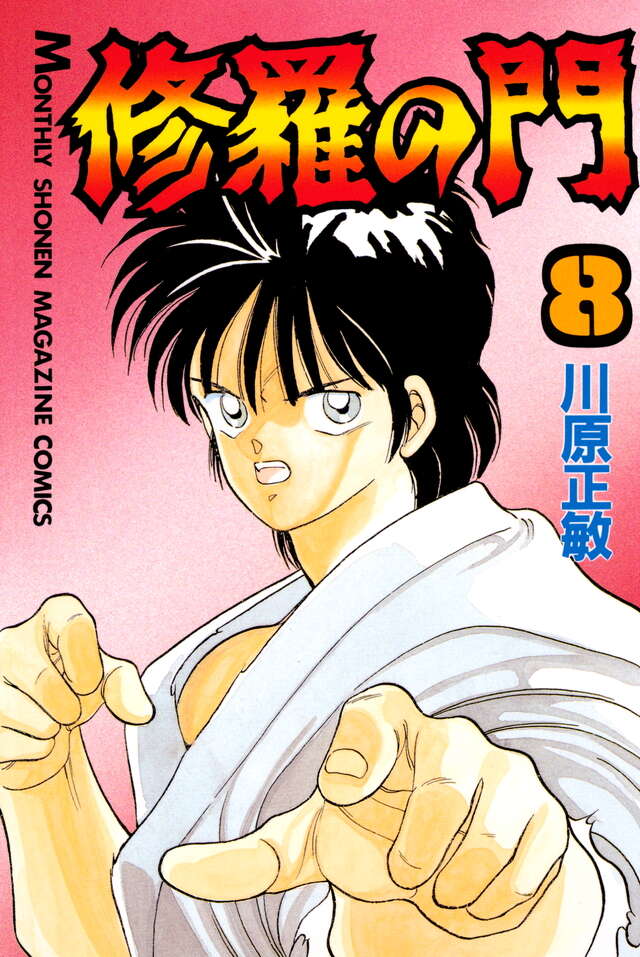
Cover of Shura no Mon, Volume 8. Tsukumo Mutsu reaches forward and looks straight ahead.
Masatoshi Kawahara, Shura no Mon, Vol. 8 (Kodansha)

Look past the hand reaching off the cover of Volume 8 and you meet Tsukumo’s gaze. Kawahara gives a look like that room to hold up a fight for a beat. That makes one of the volume’s most unnerving moments even better: across from Tsukumo, his opponent deliberately closes his eyes.

A boy walks into a karate dojo

On his way to the Shinbukan, Tsukumo asks a girl named Maiko Ryuzoji for directions. When they get there, another challenger is already demanding the dojo’s signboard, a public challenge to its reputation. Maiko steps up to defend the place. Tsukumo rests a hand on her shaking shoulder and claims the sign for himself. Kawahara gets a laugh out of the audacity before showing how seriously the dojo’s fighters take him.

What Tsukumo inherits

Mutsu Enmei-ryu is the manga’s fictional martial art, handed down through Tsukumo’s family. Its techniques were made for fights where somebody might die. Tsukumo wants to see how far his strength can take him, but the closer a rival pushes him to his limit, the more dangerous those inherited techniques become. When he tells Maiko he hopes to win without using one of them, the cost of carrying that family name starts to come into focus. How he came to inherit it is one of the story’s slow revelations.

What Maiko sees

Maiko is the granddaughter of Tesshin Ryuzoji, the man who founded the Shinbukan. She knows what a dojo challenge means and sees what the other fighters can overlook. When a battered Tsukumo tries to go straight from one fight into another, she grabs hold of him to stop him. Later, when she wants him to win, that earlier scene still matters. You know how frightened she has been for him.
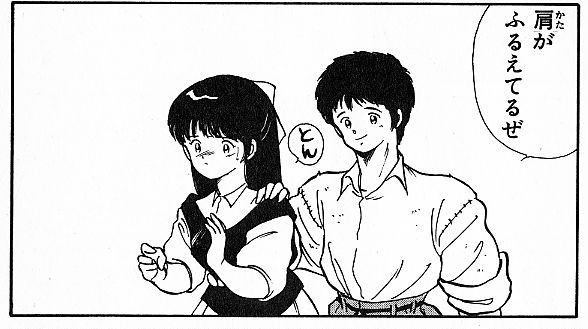
Tsukumo rests a hand on Maiko’s shoulder
Volume one. Before Tsukumo makes his ridiculous claim on the signboard, he notices that Maiko is trembling.Masatoshi Kawahara, Shura no Mon, Kodansha, Vol. 1, p. 17

Akira Kaido waits for daylight

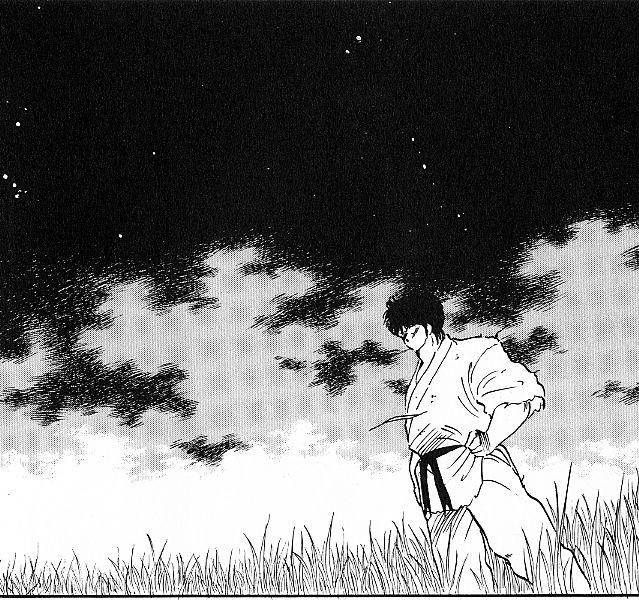
Akira Kaido is the standout among the Shinbukan’s karate fighters. He and Tsukumo face each other in the grass outside the dojo. Maiko sees two people standing still. Kimura, another Shinbukan fighter, can tell the fight has already begun. By the time the sun comes up, Kawahara has made even a step feel worth waiting for.

Kaido and Tsukumo face each other under a dark sky
Kawahara gives the night sky most of the panel. The small figures make you wait for one of them to break the stillness.Masatoshi Kawahara, Shura no Mon, Kodansha, Vol. 2, p. 154

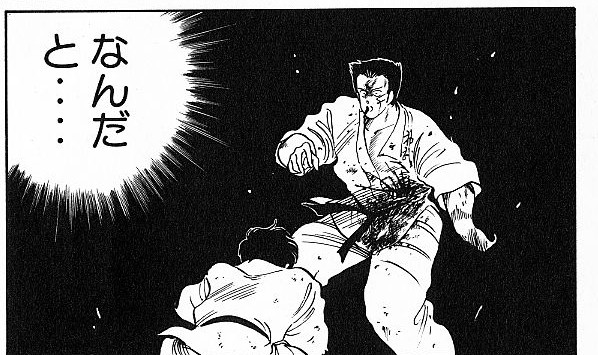
Once they move, Kaido shows why giving him a second look at a technique is such a bad idea. He gets clear of a blow that caught him earlier and comes back with his own Double Dragon Kick. Late in the fight, Tsukumo throws a punch that Kaido seems to slip past. The panel goes black. Tsukumo calls the technique Mukuha, and Tesshin pieces together what happened. The drawing lets you feel the danger while you’re still thinking Kaido made it clear.

Kaido senses something wrong against a field of black
The sudden black isolates Kaido after the apparent dodge and makes the pause feel like part of the blow.Masatoshi Kawahara, Shura no Mon, Kodansha, Vol. 3, p. 84

Takaaki Hida wants the whole fight

The action moves from the dojo to a tournament open to different fighting styles. Takaaki Hida comes from professional wrestling. He’s spent years wondering how much strength he’s had to leave in reserve. Before facing Tsukumo, he admits he’s afraid. The prospect of finally finding out what he can do excites him anyway.

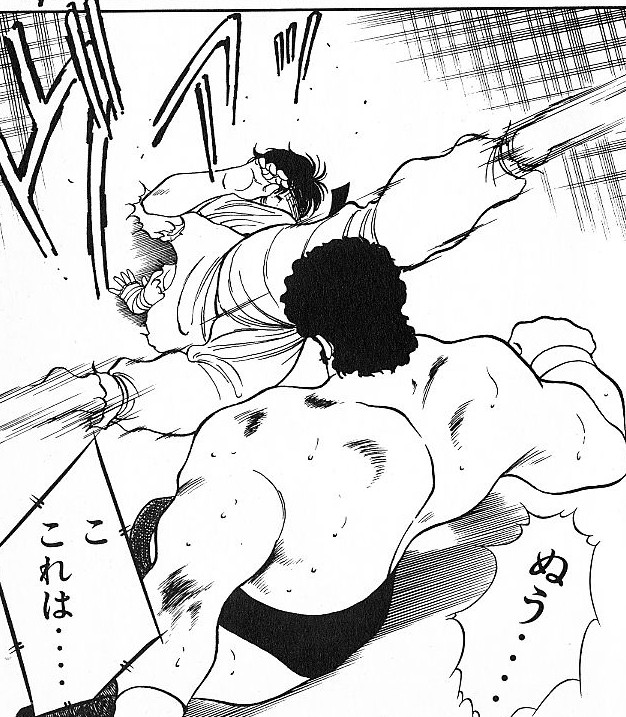
Hida keeps moving even after the second Koho, one of Tsukumo’s short-range blows, and answers it with a throw. Before the match, Tsukumo had confided in Maiko that he hoped to get through it without using Ryuha. Now Hida insists on seeing everything he has. I wanted to see that move and wanted Hida to be all right. Kawahara makes both feelings hit at once.

Tsukumo’s legs sweep through the panel as Hida meets Ryuha
The arc runs past Hida’s shoulder. Your eye follows it before you can tell what the move has done.Masatoshi Kawahara, Shura no Mon, Kodansha, Vol. 7, p. 21
Spoilers: how Hida’s fight ends, and why the boundary matters later

After Ryuha, Tsukumo comes up behind Hida. His arm looks like part of a follow-up attack. He’s actually holding pressure on Hida’s wound. Hida walks out of bounds himself. Later, in the final, Hida tells Tsukumo to step around that same line. Tsukumo won’t cross it. After seeing Hida give up the fight with a step, you understand why moving even an inch costs Tsukumo something.

Ukyo Katayama closes his eyes

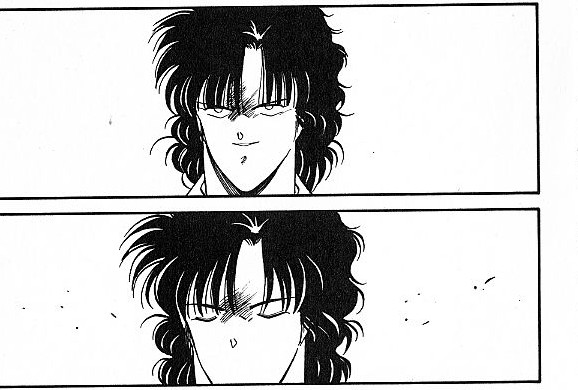
Ukyo Katayama is a gifted karate fighter from Kidokan, a rival dojo. Tsukumo has had him in his sights since before the tournament. Ukyo studies Hida’s match, so he’s seen what Ryuha can do before it comes for him in the semifinal. He drops his guard and closes his eyes. That single decision makes the fight feel more dangerous than any show of speed could.

Two wide panels show Ukyo Katayama closing his eyes
Two close-ups in almost the same framing let the closing eyes carry the action.Masatoshi Kawahara, Shura no Mon, Kodansha, Vol. 8, p. 13

Ukyo has a maddening weapon of his own, a palm strike called Bosatsusho. Once it has driven Tsukumo back to the boundary, Tsukumo charges straight toward the man who nearly put him down. Kawahara switches the viewpoint behind Tsukumo for the Koho exchange. Your sense of distance disappears before you hear anybody explain what Tsukumo learned from taking the first hit.

Hokuto Fuwa knows the family style

In the other semifinal, the Shinbukan’s founder, Tesshin Ryuzoji, gets back on his feet against Hokuto Fuwa and wants Kaido to see what happens next. Hokuto comes from the Fuwa Enmei-ryu, a tradition that branched off from the Mutsu family’s fighting school. You can see why Shingen Mutsu, Tsukumo’s grandfather, pays such close attention from the sidelines. Moves handed down in his own family keep turning up on both sides of this tournament.

In the final, Tsukumo recognizes the beginning of a move, and Hokuto uses that recognition to send him the wrong way. Hokuto wants to bring his lineage into the open. Tsukumo wants his own to end with him. As the fight goes on, Tsukumo measures what he’s seeing against the speed and sheer stubbornness of earlier opponents. Every match has taught him to notice something he couldn’t see before. Here he meets someone who can make even that knowledge a liability.

Alios Kilrain makes the ring feel small

Next comes heavyweight boxing. The boxer who gave Alios Kilrain a home also gave him a craft to take pride in. That history comes into the ring with him. Tsukumo interrupts one of his long combinations. Alios comes back with fewer punches and more weight behind each one. There’s a wonderful menace to that economy. The whole ring starts to feel too small for Tsukumo.

In Brazil, Ignacio da Silva brings it back to karate

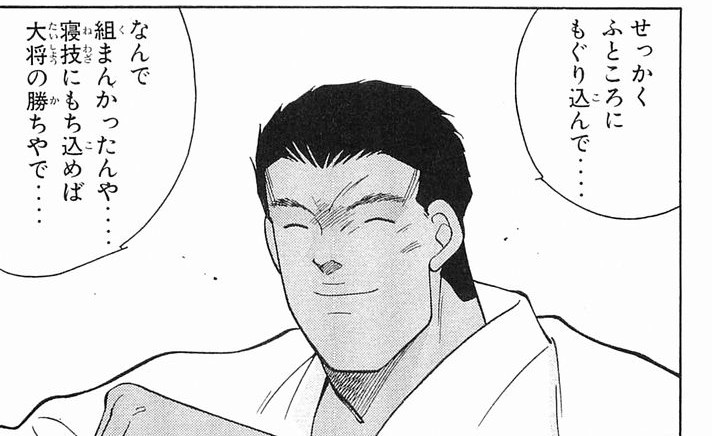
Tsukumo’s run in Brazil’s vale tudo tournament brings him up against Ignacio da Silva, a former soccer player who found his way to Shinbukan karate. That takes us back to the dojo of the opening volumes. For Ignacio, the attraction was that both fighters could find out for themselves whether a technique worked. He sounds as eager as Tsukumo to discover what the man in front of him can do.

Ignacio smiles in the middle of the fight
Ignacio’s easy smile is already there before the bursts of movement. It’s the expression you least expect from someone this dangerous.Masatoshi Kawahara, Shura no Mon, Kodansha, Vol. 28, p. 33

A kick that seemed manageable a moment ago sends Tsukumo flying. Later, the men watching from the Shinbukan recognize a variation on Kaido’s Double Dragon Kick. It’s a lovely echo: a move we first saw in the grass outside a Japanese dojo turns up again in Brazil, and Ignacio has found a use for it of his own.

Start with the first visit to Shinbukan

If you love a fight where the mere act of closing your eyes can make you turn the page faster, start with volume one. The first time you see Tsukumo smile, remember the look. You’ll spend a good part of the series watching to see when it changes.

The editions below are in Japanese. For a print set from Japan, check delivery and the full shipping cost for your destination. Kobo availability can vary with your account region.